Posted on

Art Deco Jewellery – A Buyers Guide

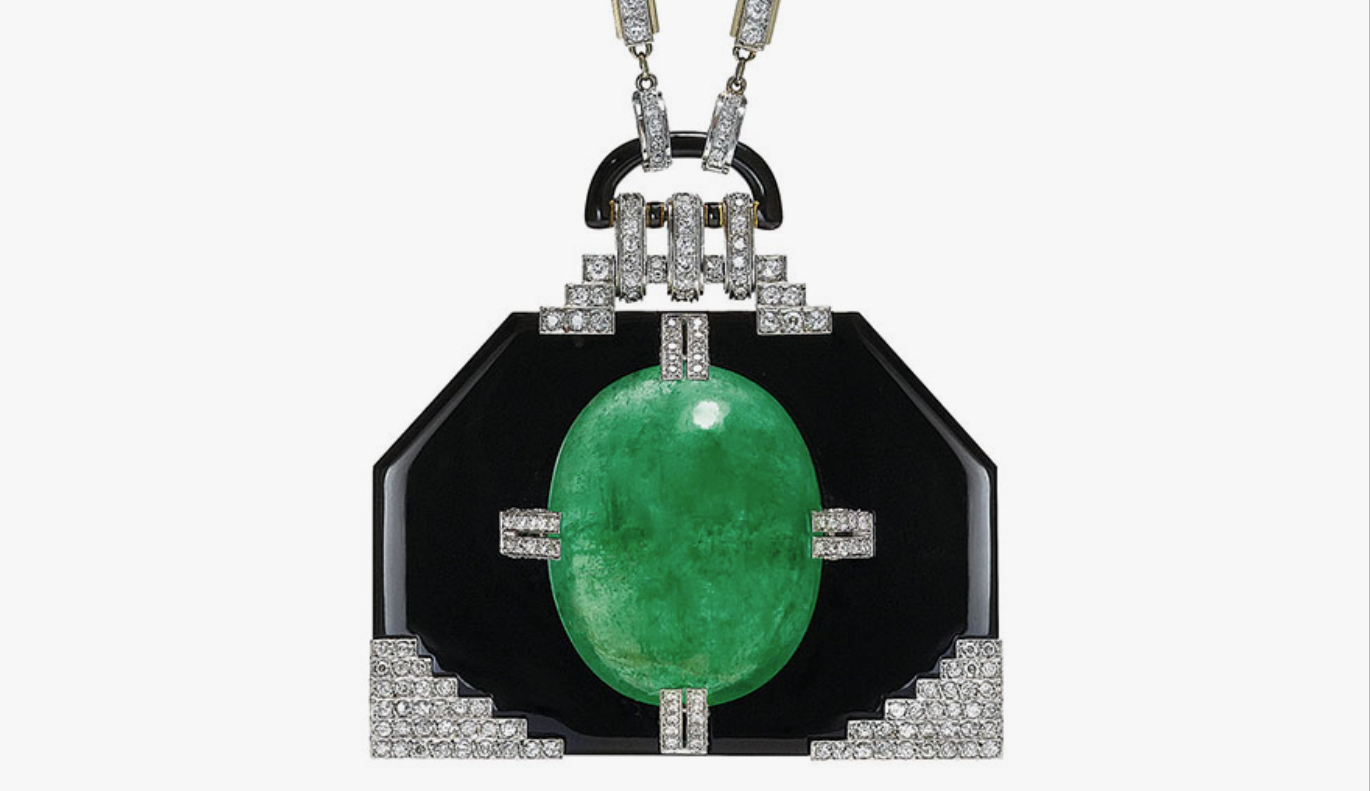
An important emerald, onyx and diamond pendant necklace by Georges Fouquet - (c)Christies

Art Deco Jewellery: A Complete Buyer’s Guide (1920–1940)

Few design movements have left such a lasting impression as Art Deco. From the clean lines of modern architecture to the glittering glamour of 1920s jewellery, Art Deco celebrates confidence, craftsmanship and the joy of modernity.

At Anadej, it remains one of our favourite eras. Every piece tells a story of innovation, resilience and exquisite design, and it continues to inspire collectors around the world. Whether you’re new to antique jewellery or expanding your collection, this guide will help you appreciate the beauty and significance of authentic Art Deco pieces.

The Art Deco Era: 1920–1940

The Art Deco period emerged after the First World War, when the world longed for renewal. Social change was rapid: women had entered the workforce, fashion became freer, and society embraced a new sense of energy and independence. Jewellery mirrored that shift.

Gone were the flowing curves of Art Nouveau and the delicate lacework of Edwardian design. In their place came geometry, proportion and bold colour. These were jewels made for modern women who lived with confidence and style.

What Defines Art Deco Jewellery

Art Deco jewellery is instantly recognisable by its harmony of structure and sparkle. Inspired by the precision of modern design, it was still meticulously handcrafted.

Typical features include strong geometric forms such as zigzags, chevrons and sunbursts, balanced symmetry and striking contrasts of colour. Platinum and white gold were favoured for their cool brilliance, setting off diamonds and coloured gems to perfection.

True Art Deco design feels architectural, balanced and unmistakably elegant.
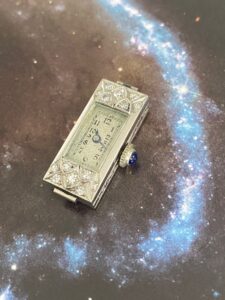
Art Deco Diamond and Platinum Watch Head - Anadej
Art Deco Diamond and Platinum Watch Head – Anadej @anadej.jewellery
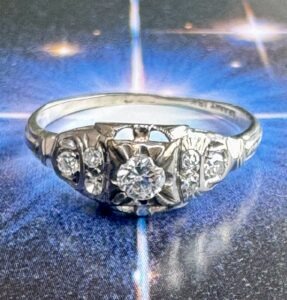
Art Deco Diamond Ring - Granat Brothers - 18ct White Gold
Art Deco Diamond Ring – Granat Brothers – 18ct White Gold


Motifs and Global Influences

The 1920s were a time of exploration and discovery, and jewellers drew inspiration from many cultures and artistic movements.

Egyptian motifs flourished after the discovery of Tutankhamun’s tomb in 1922, with scarabs, lotus flowers and pyramid forms appearing across Europe. Designers were also fascinated by Japanese lacquer work, Chinese jade carving and the vibrant colours of Indian gemstones. Movements such as Cubism and the Bauhaus encouraged abstraction and geometry.

Together these influences created jewellery that felt both ancient and modern – a perfect reflection of the Jazz Age.

Gemstones and Metals of the Art Deco Period

Art Deco jewellery combined technical innovation with opulent materials.

Metals
Platinum became the metal of choice, valued for its strength and ability to hold intricate designs. As it grew expensive, white gold rose in popularity, while silver and chrome appeared in bold costume pieces.

Gemstones
Diamonds dominated, especially in emerald and baguette cuts. Coloured stones brought vibrancy: emeralds, sapphires, rubies, jade and coral were particularly admired. Onyx, rock crystal and enamel provided dramatic black-and-white contrast. Synthetic rubies, sapphires and even bakelite allowed for more accessible designs without sacrificing style.

Collectors often look for calibré-cut gemstones, where tiny, precisely cut stones fit seamlessly together in mosaic-like patterns – a hallmark of the era’s craftsmanship.

Types of Art Deco Jewellery

Rings
Statement rings defined the era. Large coloured gemstones were surrounded by geometric arrangements of diamonds, often in platinum settings. Millgrain edging and fine filigree work added delicate detail.

Necklaces
The sautoir epitomised Deco glamour: long strands ending in tassels or pendants, often tied loosely at the front or draped down the back. Multi-strand pearl or bead necklaces with diamond plaques were popular day-to-evening choices.

Bracelets
Wide bangles and articulated panels reflected the linear style of the time. Repeating patterns of gemstones and enamel created a sense of rhythm and movement.

Earrings
Early Deco earrings were long and elegant, designed to complement short hairstyles. By the 1930s, clip earrings that sat neatly on the earlobe became fashionable. Many designs were cleverly adaptable, doubling as dress clips or brooches.

Brooches and Dress Clips
Brooches were essential accessories, worn on lapels, hats and handbags. Dress clips could be worn singly or paired together for a larger statement.

Hair Ornaments
While tiaras remained for formal occasions, the more relaxed bandeau became the choice for modern women. These were often convertible, designed to transform into bracelets or necklaces.

Craftsmanship and Innovation

The Art Deco era was a time of remarkable technical progress.

Van Cleef & Arpels introduced the mystery setting (serti invisible), where gemstones appear to float without visible metal. Gem cutters developed shield, hexagon and calibré shapes that allowed for intricate, seamless designs.

Cartier led with platinum and diamond creations of exceptional precision. Tiffany & Co. brought Deco elegance to the American market, while Georges Fouquet’s emerald and onyx designs embodied French sophistication. Each genuine Art Deco piece feels like a small feat of engineering, a perfect balance between artistry and structure.

British Art Deco Designers

Britain’s contribution to Art Deco jewellery had its own character – refined, inventive and distinctly modern.

Notable names include H.G. Murphy, whose silver and gold work reflected sculptural simplicity; Bernard Instone, known for his elegant, colourful designs; and The Artificers’ Guild, whose craftsmanship bridged the Arts & Crafts tradition with early modernism.

Their creations helped shape a uniquely British interpretation of the Art Deco aesthetic, combining tradition with the excitement of new design.

Collecting and Identifying Authentic Art Deco Pieces

When evaluating Art Deco jewellery, craftsmanship is the key indicator. Look for precise symmetry, clean lines and quality materials. Platinum or white gold mountings, step-cut diamonds and fine handwork are strong signs of authenticity.

Hallmarks can reveal a piece’s origin and maker, while gentle, consistent wear supports its age. Be cautious of modern reproductions: they may echo the style but rarely capture the depth and refinement of original designs.

Caring for Art Deco Jewellery

Antique jewellery deserves careful attention. Clean pieces gently with mild soap and warm water, and dry with a soft cloth. Avoid ultrasonic cleaners, which can loosen old settings. Have platinum or gemstone pieces checked annually by a trusted jeweller, and store each item separately to prevent scratches.

For valuable pieces, consider insurance that reflects their current replacement value.

Famous Designers and Makers

  • Cartier – masters of platinum and diamond precision
  • Van Cleef & Arpels – pioneers of the mystery setting
  • Tiffany & Co. – leaders of American Deco glamour
  • Georges Fouquet – known for bold colour contrasts and strong geometry
  • René Lalique – transitioned gracefully from Art Nouveau to Deco
  • H.G. Murphy and Bernard Instone – leading figures in British Art Deco design

FAQs

What years define the Art Deco jewellery period?
Approximately 1920 to 1940, overlapping with the later Edwardian and early vintage eras.

How can I tell if a piece is genuine Art Deco?
Look for symmetry, step-cut gemstones, platinum or white gold, and subtle wear that reflects its age.

Are all Art Deco pieces considered antique?
Yes. Early 1920s designs are now over a century old, while late 1930s pieces are classed as vintage.

Which gemstones are most typical?
Diamonds, sapphires, emeralds, rubies, jade, onyx and coral, often used in bold colour contrasts.

How should I care for my Art Deco ring?
Clean gently with mild soap and water, avoid chemicals and ultrasonic cleaning, and have the settings checked regularly.

Explore Our Collection

At Anadej, we curate an ever-evolving collection of authentic Art Deco jewellery – from diamond sautoirs and statement rings to bracelets and brooches. Each piece captures the optimism and artistry of the Jazz Age, where design met daring innovation. Discover our available Art Deco jewellery here.

Other Resources for more about the Art Deco Era and it’s jewellery

TV:  One of my favourite programmes when I was younger was ‘House of Elliot’ – series 1 can be streamed on Amazon Prime in US.

GIA Article: Can be found on this link.

Books:

Art Nouveau and Art Deco Jewellery: An Identification and Value Guide – Lillian Baker

Authentic Art Deco Jewelry Designs – Franco Daboni

Other Antique Jewellery Buyers Guides:
Georgian Jewellery

Victorian Jewellery 

Art Nouveau Jewellery 

Edwardian Jewellery


Posted on

Art Nouveau Jewellery – A Buyers Guide

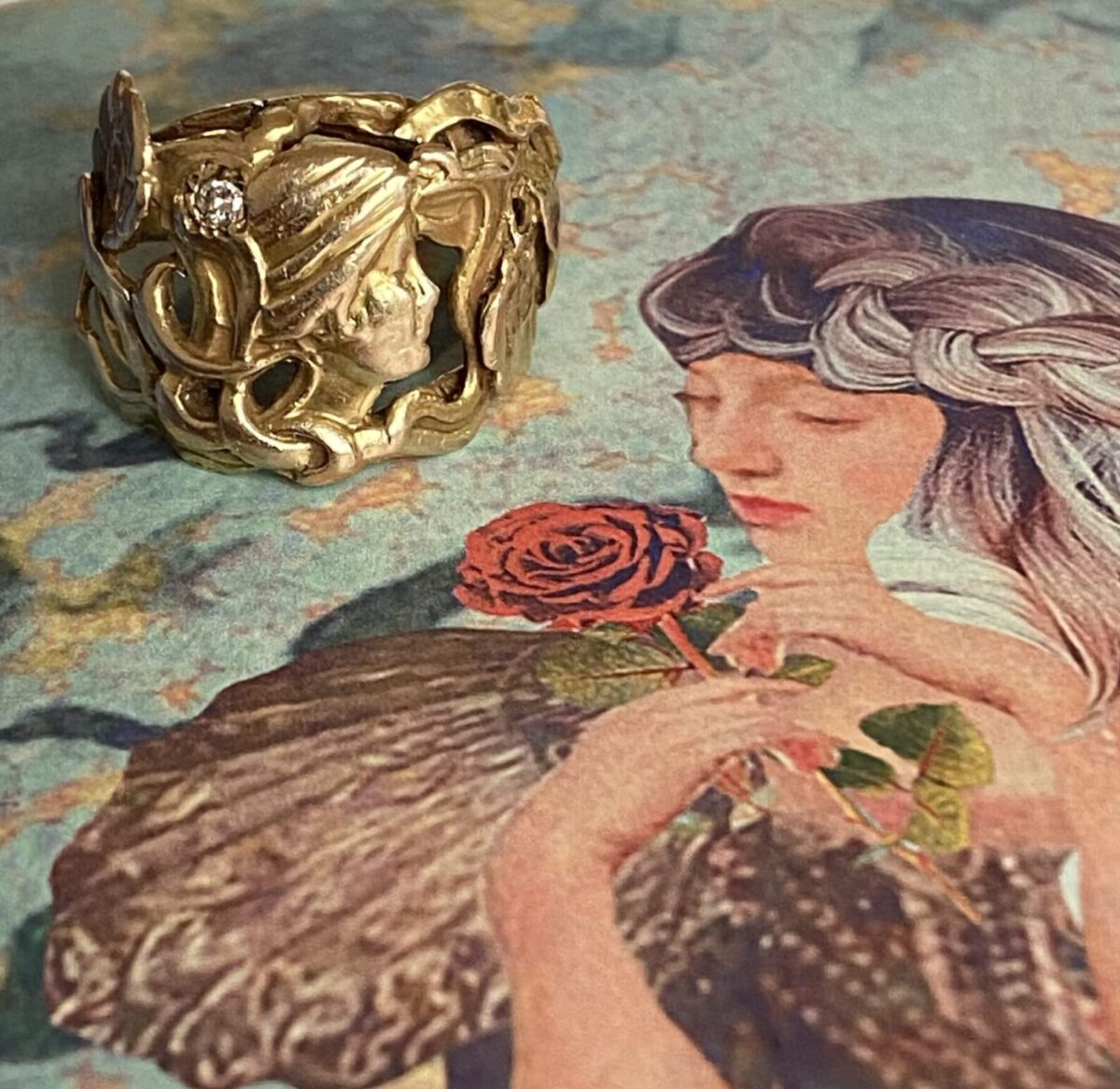
Art Nouveau Ring

The Art Nouveau Period (1890-1915)

Although short in time, the Art Nouveau period was significant in jewellery design and other decorative arts.  Art Nouveau jewellery originated in France, Belgium and other parts of Europe, with influences from Japonisme and was created by a small group of Avant Gard artists. It marked the transformation from the Victorian period in to the modern. In the UK specifically, it was born out of the Arts and Crafts period (1860s-80s) and crossed over the late Victorian aesthetic period and Edwardian era.

In this period jewellers really considered themselves artists and you can see why with the incredibly detailed and flowing style of the jewellery available at this time. You can absolutely see the craftsmanship that has gone into each and every piece. There was a rejection of the mass produced jewellery and a move back to hand crafted pieces with fluid, free-flowing design inspired by the natural world.

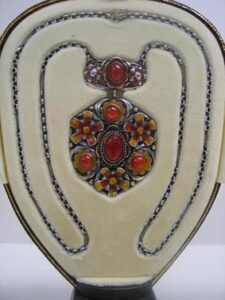
It is one of our absolute favourite periods here at Anadej in terms of the jewellery, artwork, architectural design, and homewares that were available at the time.  Indeed, our owner has family connections with Art Nouveau Jewellery specifically, as a great, great niece to Ella Naper.  Ella Naper (nee Champion) was a celebrated artist, potter, designer, and jewellery maker.  She was an active member of the Newlyn School, along with her husband Charles Naper and friends Laura Knight and Harold Knight who she collaborated with often. Ella exhibited at the Arts and Crafts Exhibition, Woman’s Art Exhibition and also sold pieces through Liberty’s of London.  Her pieces are very well regarded and are popular collectors’ items to this day.

Ella Naper Necklace
Silver and Enamel Necklace by Ella Naper – On display at Penlee House.


Motifs and Symbolism in Art Nouveau Jewellery

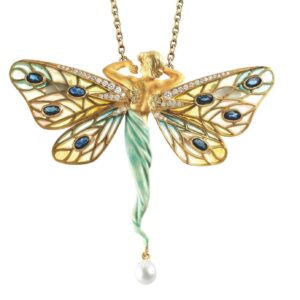
Art Nouveau jewellery was soft, romantic, and often mystical. Pieces would often include depictions of the natural world, with a focus on the language of flowers. The female form was celebrated too, often blending with elements from insects, like the butterfly or dragonfly, floral motifs, and sometimes other winged creatures like bats!

Fluid lines and a sense of the piece as a whole, rather than disparate elements making up a design, was a key feature in this period. Enamelling gained popularity during this period and plique-a-jour was a popular technique. Plique-à-jour is backless enamel and allows light to come through to give a three-dimensional quality, creating an effect of translucence.

In the Art Nouveau period colours used were more muted and pastel, adding to the dreaminess of the piece.

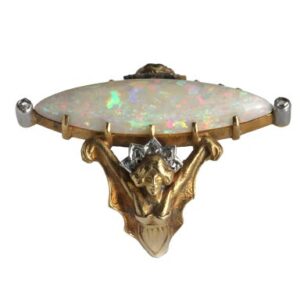
Art Nouvevau Bat Ring
Charles Boutet de Monvel Art Nouveau Opal Diamond Ring – Tadema Gallery – Available via 1st Dibs
Art Nouveau Butterfly Necklace - Art Nouveau Club
Art Nouveau Butterfly Necklace – Art Nouveau Club


Gem Cutting Styles and Settings in Art Nouveau Jewellery

The settings and styles in Art Nouveau jewellery were often incredibly unique and individual to the piece being created and the gems being used. For diamonds, the cut was usually either the old mine or old European cuts (a forerunner to the modern brilliant cut).

Popular Gemstones in Art Nouveau Jewellery

There wasn’t such a focus on the gem value during the Art Nouveau period, indeed, gems were often used more as an accent to the metal work/settings rather than as the central focus. The value in the piece came from the work and artistry involved. Gems used included; small diamonds, opals, pearls, tourmaline, emeralds, lapis lazuli, moonstone, carnelian, amber and synthetic gems.

We obviously can’t do an article about Art Nouveau Jewellery without mentioning Rene Lalique who was really the founding father  in experimental jewellery craftsmanship, leading the way with new enamelling techniques, putting the artwork above all else.

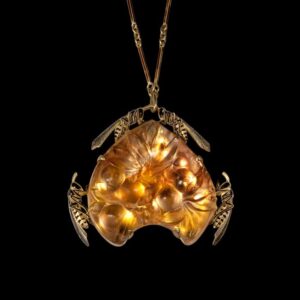
Rene Lalique Necklace - Musee Lalique (c)
Rene Lalique Necklace – Musee Lalique (c)


Metals Used in Art Nouveau Jewellery

Precious white metal e.g., platinum, white gold, palladium, and silver was used more commonly than yellow or rose gold, however, 14ct and 18ct gold was used during this period.

Our range of Art Nouveau Jewellery

Our range of Art Nouveau jewellery is ever evolving as we find more pieces to bring you joy, our current range can be found here.

Further resources:

  • Ella and Charles Naper and the Lamorna Artists – John Branfield
  • Art Nouveau Jewelry – Vivienne Becker
  • Art Nouveau Club – link 

Other Antique Jewellery Buyers Guides:
Georgian Jewellery

Victorian Jewellery 

Edwardian Jewellery

Art Deco Jewellery

Posted on

Georgian Jewellery – A Buyers Guide

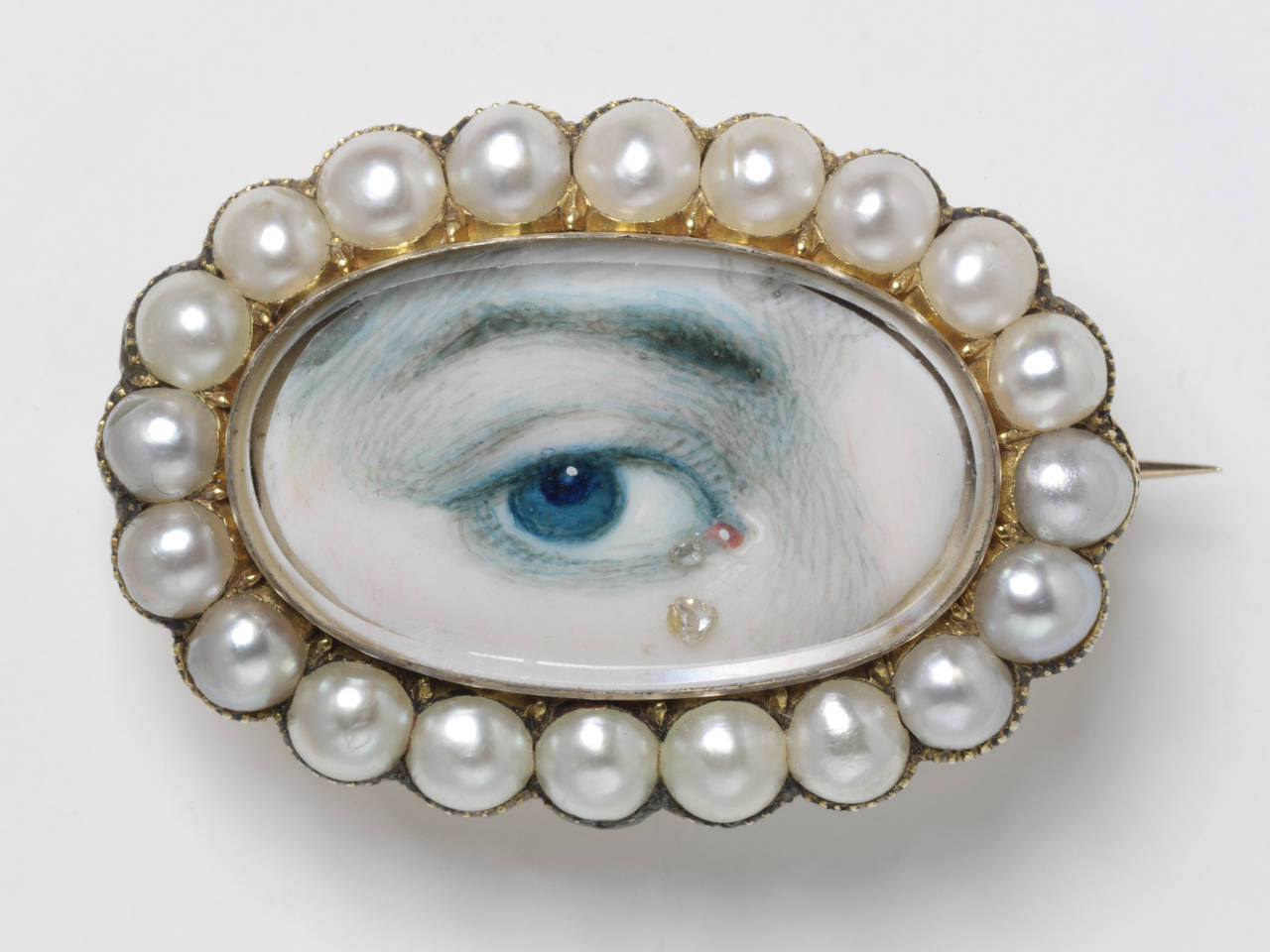
Lovers Eye at the Victoria and Albert Museum - Lot number p.56-1977

The Georgian Period (1700-1830)

The Georgian period was so named after the four King Georges who ruled in succession throughout this period. It was a prosperous and revolutionary time, particularly in politics, art and architecture, with many technological advancements happening at this time. There were huge developments in science and of course exploration. There was also a changing role for women in society. This all provided a great backdrop for developments in jewellery of the time.

It wasn’t just in Britain, where things were developing at pace and with politics running wild. For example, in America, George Washington was President, and it was a period marked by a Revolution. In France, Louis XVI and Marie Antoinette were at the helm during the French Revolution and Napoleon.  In Russia, Catherine the Great reigned.

For Georgian jewellery history, the period spanned from 1714 to 1830 and encompassed the reign of George I, George II, George III and George IV.

During the Georgian period, intricate metal work depicting natural themes came into fashion. This is called repoussé (an example of a repoussé bracelet is shown below). In addition, the use of faceted gemstones became all the rage.

Motifs and Symbolism in Georgian Jewellery

Flowers, butterflies, ribbons, and scrolls were popular motifs in Georgian jewellery. Sentimental jewellery like the ‘lover’s eye’ and also mourning jewellery was popular at this time. One of our favourites, acrostic jewellery (taking the first letter from popular gemstones to make a word, like regard, love, dearest) was also popular.

Gem Cutting Styles in Georgian Jewellery

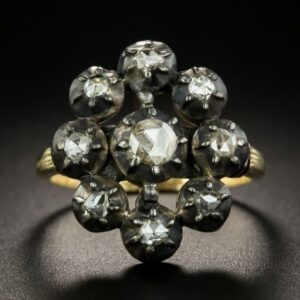
Table cuts, rose cuts, and old mine cuts were the cuts of the day. Table cuts are not often seen on the market and have both a flat top and bottom and are either square or rectangular. Rose cuts have a flat bottom with a domed faceted top (fairly large facets, not always even). Old mine cuts are the most similar to today’s brilliant cut.

Georgian diamond rose cut cluster ring
Beautiful example of a Georgian Rose Cut Diamond Ring from Lang Antiques
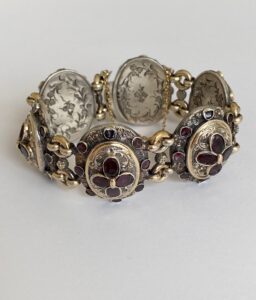
Georgian Repoussé bracelet
Georgian Table-Cut Garnet Bracelet in Repousse style, with floral design to back. From Anadej

Popular Gemstones and Settings in Georgian Jewellery

The most popular ring stone in Georgian jewellery was the diamond, which was used almost exclusively up until 1750. Diamonds and white paste were more usually set in silver, or silver over 18ct or higher gold.

Garnets, emeralds, topaz and amber were also used. Georgian jewellery was mainly hand crafted and gems were often set in closed settings with foil backing for enhancement. The crimped collet setting as seen in the picture of the rose cut cluster ring from Lang Antiques was very popular at the time. Open settings had not become common during this period.

Paste (different types of cut glass, often coloured) was extremely popular in the 18th Century, as was enamel work.

Metals Used in Georgian Jewellery

Silver over 18 carat gold was often used to highlight colourless gems, e.g. diamonds and clear paste.  High carat gold was the order of the day especially 18 carat or  22 carat yellow gold. Instead of lower carat golds, pinchbeck (83% copper and 17% zinc) was used to give the appearance of gold.

Jewellery was often not hallmarked in the Georgian period as it was not a legal requirement to do so.

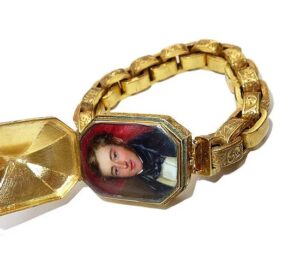
Rare Georgian Pinchbeck Locket Bracelet available at Antique Animal Jewelry
Beautiful example of a Georgian pinchbeck locket bracelet with a water colour of a gentleman inside. Available at Antique Animal Jewelry.
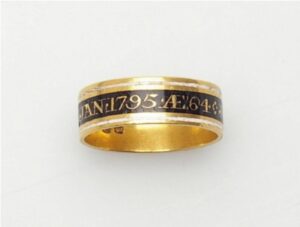
Georgian Jewellery
Georgian Mourning Ring for Josiah Wedgewood. Available to view at London’s Victoria and Albert Museum

Rarity and Resources for Georgian Jewellery

Rings from the Georgian Period are now exceedingly rare and there are many forgeries on the market, so special attention must be paid to the style and quality of the ring.

We don’t carry many Georgian pieces at Anadej; however, we would be delighted to help you search if you were after a special piece or suggest other antique jewellery specialists.

We can recommend Antique Animal Jewelry as they are Georgian Jewellery experts and carry a significant and incredible collection and have fascinating blogs on the subject.

A wonderful book full of fantastic information on Georgian Jewellery is: Georgian Jewellery: 1714-1830 by  Ginny Redington and Olivia Collings.

Other Antique Jewellery Buyers Guides:
Georgian Jewellery

Victorian Jewellery 

Art Nouveau Jewellery 

Edwardian Jewellery

Art Deco Jewellery